
Coolant, changed on condition.
Not on a calendar.
An inline fluid-quality valve we built in-house. It sits right in the dry-cooler loop, reads the coolant as it flows past, and projects how many days of life it has left. Two valves per loop, one on the inlet and one on the outlet, wired straight into our own BMS. Stainless, flanged, going into HN1 Phase 1 in Hyderabad.
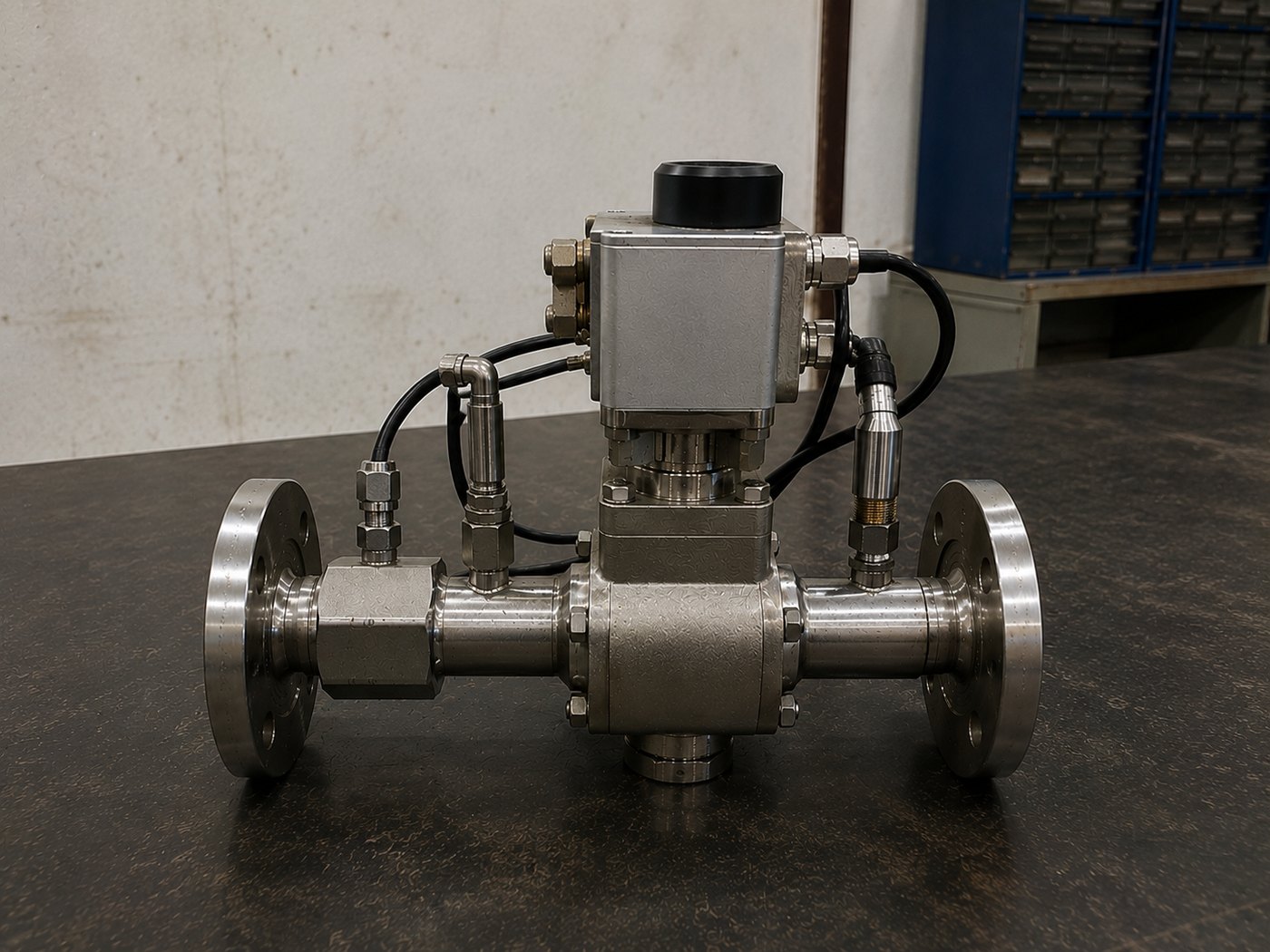
The inline quality valve on the bench. Stainless, flanged, two per loop. PQV-B1-01 on the PGW25 dry-cooler loop.
We used to change coolant
on a calendar.
Pick a date, drain the loop, refill, move on. Half the time the fluid was still perfectly good and we binned it. The other half it had quietly gone off weeks before anyone thought to look. Nobody enjoys draining 25% propylene glycol that still has life left in it, and nobody enjoys finding out the inhibitor packed up after the fact.
So we built this instead.
It reads the fluid
as it flows past.
An inline quality valve that sits in the dry-cooler loop and senses the coolant in real time. All live, all on the BMS. No sample bottles, no waiting on a lab, no guessing in between.
It tells you how many
days the fluid has left.
The part we are happiest with. The valve does not just say the fluid looks fine today. It projects how many days it has left, and maps the sampled colour against condition, clear and fresh at one end through to end of life at the other. So coolant changes when the fluid says so, not when a spreadsheet says so.
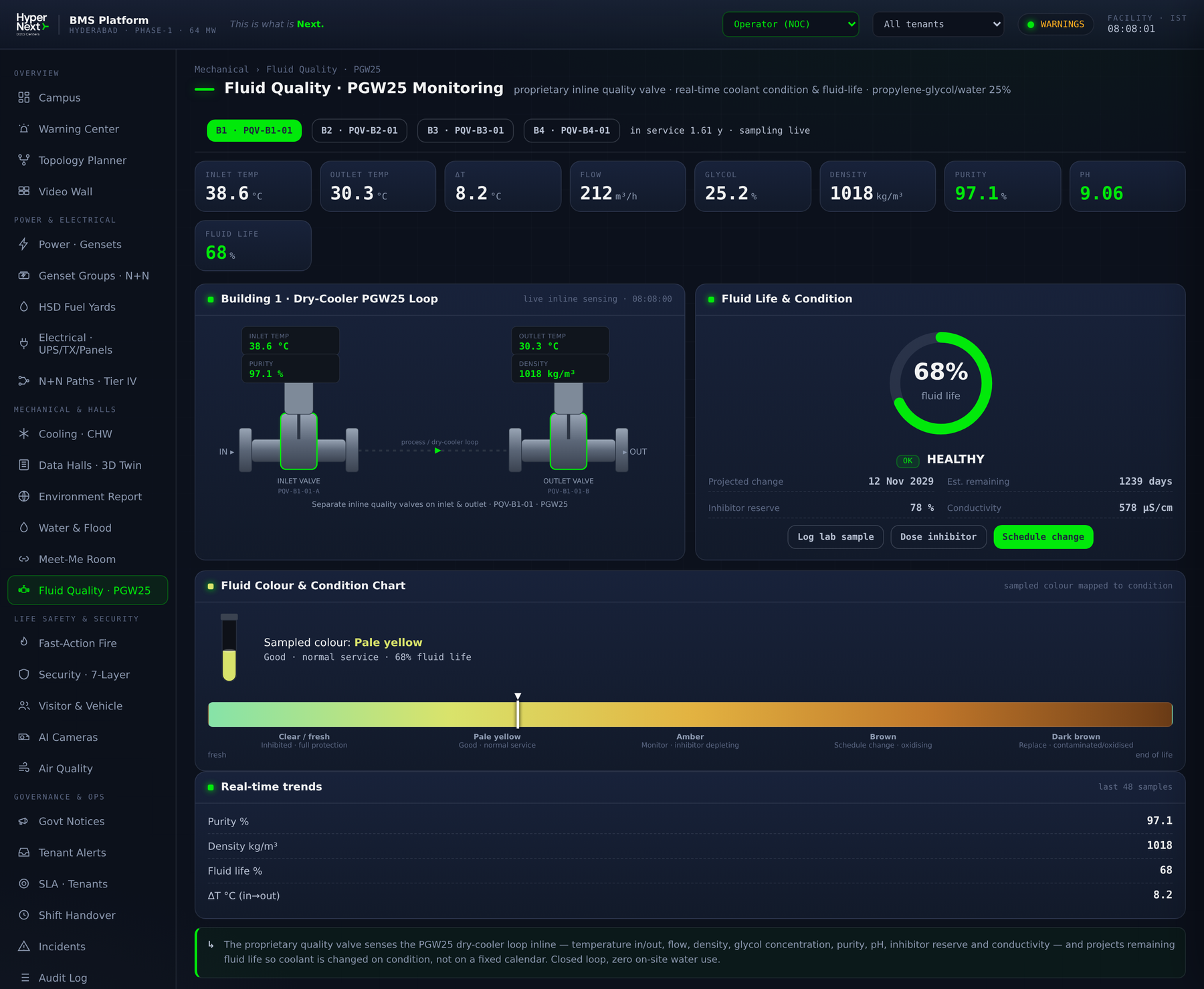
Building 1, PGW25 loop on the HyperNext BMS. Live inline sensing, a fluid-life projection, and sampled colour mapped to condition.
Two of our building loops are sitting around 68 to 71% life right now, with well over 1,200 days projected. We will run them until they are actually done, not until a date on a maintenance plan tells us to drain them.
The loop is closed.
On-site water is zero.
The loop is closed and dry-cooled, so on-site water use stays at zero. That is not a line for a brochure, it is the reason the chemistry has to be watched this closely. There is no make-up water topping things off and hiding our mistakes for us.
Small box. Big difference.
Built in-house, running on our own BMS. A small box that stops a lot of good fluid going down a drain for no reason, and catches the bad fluid before it costs us a loop.
See what else we
build in-house.
From an 800VDC power architecture to a BMS that watches the coolant chemistry in real time, the hard parts are engineered here, not bought off a shelf. If you want to talk about how this runs inside an HN1 deployment, we are happy to.