
Direct-to-chip cooling.
No CDU. No rip-and-replace.
A hybrid direct-to-chip cooling system we built in-house for the generation of GPUs that now pull up to 1400W each. It puts liquid where the heat actually is and lets air handle the rest, rejects that heat through a compact sidecar exchanger instead of an expensive coolant distribution unit, retrofits into servers you already own, runs on any dielectric fluid or DI water, and reports to our own BMS.
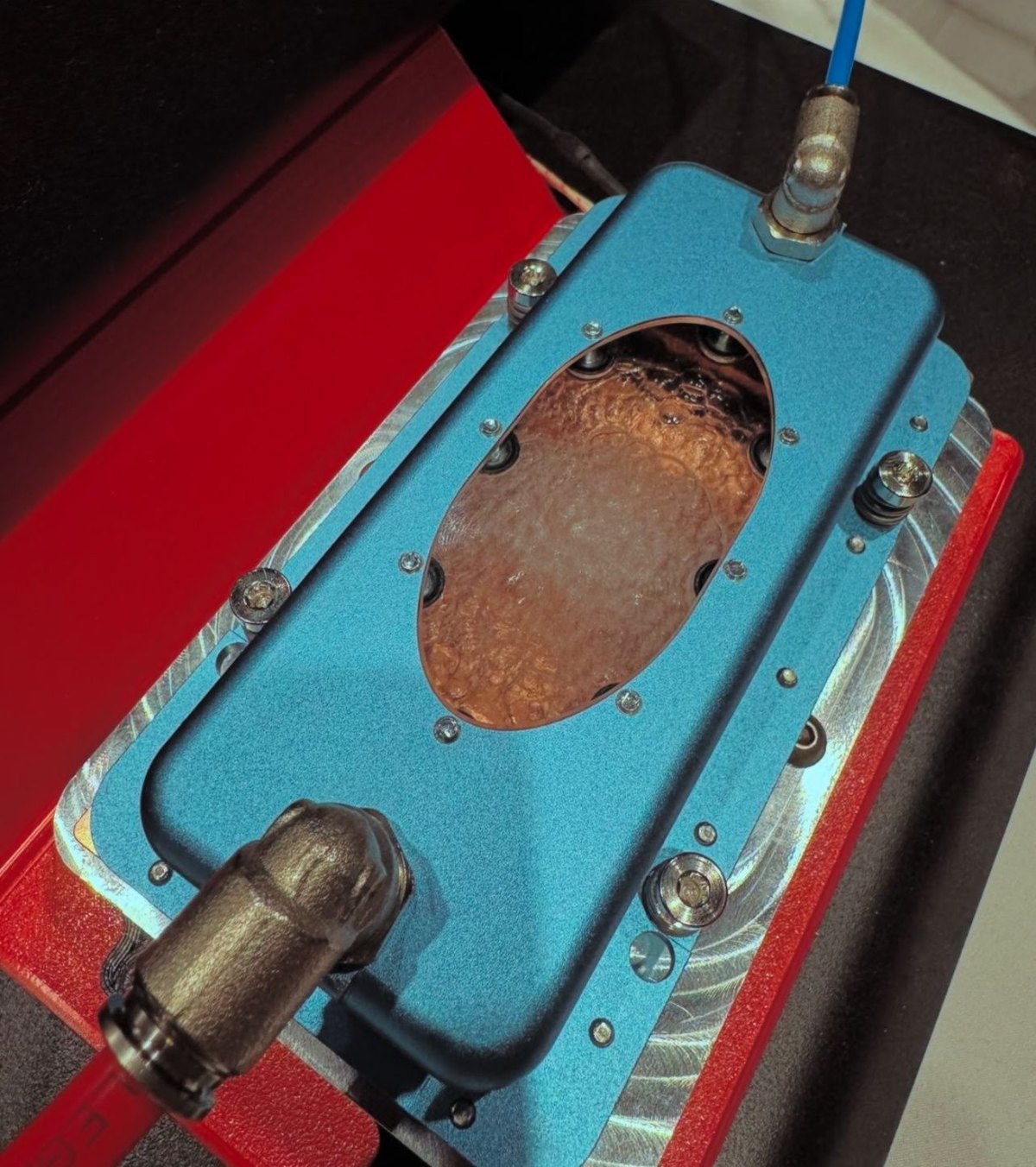
The sidecar heat-exchanger prototype on the bench. The window shows the microchannel cold plate and the coolant moving through it.
A single chip now pulls
1400 watts.
A top-end accelerator used to draw a few hundred watts. The newest pull up to 1400. Air alone cannot move that much heat out of a dense rack, and the usual fix, full direct-to-chip with a row-scale coolant distribution unit, is expensive, heavy, and assumes you are building the hall from scratch.
Most operators are not building from scratch. They have racks and servers already in the ground, and a refresh cycle that does not wait for a new cooling plant. So we built for that reality instead.
Liquid where it counts.
Air where it still works.
A hybrid. Direct-to-chip liquid cooling takes the heat off the hottest parts, the GPUs and CPUs, and air handles everything else. You cool what needs liquid and no more.
The part we are proudest of is the sidecar thermal heat exchanger. It sits beside the rack, not in a separate row of plant, and rejects the loop's heat in a fraction of the footprint and pump energy a conventional CDU needs. It runs on any dielectric fluid, or on DI water, and it asks for very little fluid top-up across a year. The chemistry is watched live on the same BMS that runs our inline fluid-quality valves, so the coolant is changed on condition, not on a calendar.
Up to 37% less
cooling power.
Against conventional cooling, the system uses up to 37% less cooling power. Less pump energy, less fan energy, less fluid, less plant. On a hall sized in megawatts, that is real money and real carbon off the bill every month.

The hybrid loop running in a rack. Liquid to the hot parts, air for the rest, all on the HyperNext BMS.
It goes into the servers
you already own.
It was designed to drop into hardware that already exists. No new hall, no row of CDUs, no forklift upgrade. The same approach fits an older-generation server as easily as a new one, which is the difference between a pilot and something you can actually roll out at scale.

Retrofit into existing nodes. The cooling is fitted to the servers, not the other way round.
What it is, in short.
Built in-house, running on our own BMS. The point was never a science project. It was a way to cool 1400W chips in racks that already exist, without a coolant plant that costs more than the servers it cools.
More from the bench.
This is one of the systems we engineered in-house rather than bought off a shelf. See the rest, or talk to us about putting them to work in an HN1 deployment.
See what else we build